Level 5 Certificate Course in Myoskeletal & Sports Massage
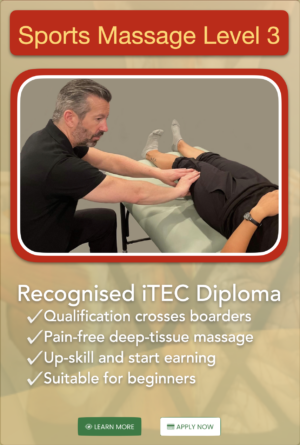
Holistic College Dublin offers a Level 5 Sports Massage course like no other – the most comprehensive, cutting edge sports massage program in Ireland. Our training program exceeds the requirements of our awarding body, I.T.E.C. and includes the concepts, special tests and techniques used in Myoskeletal Alignment Technique (MAT) and Orthopaedic Massage.
Always check that your chosen course leads to a recognised qualification from a regulated awarding body, aligned to a national framework and/or European Qualifications framework.
*The iTEC Level 5 Certificate in Sports Massage, delivered by HCD is regulated by Ofqual with a learning credit value of 25.
Duration: 6 Months Starts: Oct 2026
Total cost: € 2,300 (including iTEC exam fee)
Prerequisite: iTEC Level 4 Sports Massage.
- ITEC Level 5 Certificate in Sports Massage Therapy
- Regulated Qualification
- Practical Classroom Training
- North Dublin Venue
Course Details
-
Overview
Holistic College Dublin offers a Level 5 Sports Massage course like no other – the most comprehensive, cutting edge sports massage program in Ireland. This course teaches a comprehensive multidisciplinary, pain free, approach to the treatment of complex sports injuries and chronic pain conditions. Our training program exceeds the requirements of our awarding body, I.T.E.C. and includes the concepts, special tests and techniques used in Myoskeletal Alignment Technique (MAT) and Orthopaedic Massage.
Fully supported by our unique custom-built online learning platform with lectures and document downloads available for review 24/7.
This exciting new qualification will include the most up to date research and treatment protocols developing from international working groups such as the fascia research congress and the San Diego Pain Summit.
The iTEC Level 5 Certificate in Sports Massage, delivered by HCD, is regulated by Ofqual. Ofqual are the UK Office reporting directly to the UK Parliament for qualifications and regulation. Each iTEC/VTCT qualification bears a QAN number, which provides assurance of validity and authenticity and that it is on the RQF – Regulated Qualifications Framework. The UK regulatory framework articulates with the EQF – European Qualifications Framework for recognition of qualifications by international employers, governments and professional associations.
Always check that your chosen course leads to a recognised qualification from a regulated awarding body, aligned to a national framework and/or European Qualifications framework
-
Content
This course will progress the Sports massage therapist’s understanding from the treatment of generic sports injuries to being able to pinpoint underlying cause, effectively treat and design rehabilitation programs, to address the most complex Myoskeletal and neurological dysfunctions. Active, Passive, Resisted and Neurological tests will evaluate the nature, severity, area of injury and the type of tissue involved. Advanced techniques are then used to release myofascial restrictions and Neuro-Muscular trigger points, treat any disorganised collagen, restore normal resting tone and re-establish joint function and centration. In Myoskeletal Alignment, soft tissue manoeuvres have been developed to release osseous fixations, relieve protective spasm and improve nerve gliding through all the body’s synovial joints.
The advanced techniques used in Sports Massage include:
- Connective Tissue Massage (CTM)
- Soft Tissue Release (STR)
- Neuro-Muscular Technique (NMT)
- Muscle Energy Technique (MET)
- Proprioceptive Neuromuscular Facilitation (PNF)
- Positional release and strain/counter strain
- Myofascial Massage
- Orthopedic Massage Joint capsule release techniques
- Myoskeletal Joint Mobilising Techniques
Training will focus on precise testing, treatment and rehabilitation exercises for:
- Sprains – Anterior talofibular ligament, calcaneofibular ligament, posterior talofibular ligament, medial/lateral collateral ligament, Syndesmosis injury (high ankle injury), anterior cruciate, posterior cruciate, Acromioclavicular and Sternoclavicular.
- Strains – Peroneal tendon, Gastrocnemius/Soleus strain, Achilles tendinitis, Adductor, Quadriceps and Hamstring, Rotator cuff tears, Medial and Lateral Epicondylitis.
- Neurological injuries/soft tissue dysfunction – Nerve entrapment• Morton’s neuroma • Common peroneal nerve injury, Sciatica, nerve root v nerve trunk compression and Carpal Tunnel Syndrome.
- Fractures and Joint dysfunctions – Stress fractures, Medial tibial stress syndrome, Patello-femoral pain syndrome (chondromalacia patellae) and Patella dislocation, Glenoid labrum tear, Metacarpal fractures, Mallet finger, and Facet syndrome, Glenoid labrum tear, Subacromial bursitis and Impingement syndrome.
- Rotator Cuff Injuries and Adhesive Capsulitis (Frozen shoulder) Shoulder impingement syndrome, AC joint separation
- Soft tissue dysfunctions – Plantar fasciitis, Compartment syndrome, Bursitis, Ilio-tibial band syndrome, Piriformis syndrome, Trochanteric bursitis, De Quervain’s, Dupuytren’s contracture and Torticollis
- Postural dysfunctions – Pes planus, Pes cavus, Hallux valgus, Hammer toe, Hallux rigidus, Tibial rotation, Scoliosis, Kyphosis, Lordosis and Ankylosing spondylitis
Unique to this course:
- James Waslaski’s approach to the treatment of Sprains and Strains, and differentiating between Tendonitis, Tendonosis and simple tendon pain.
- Erik Daltons approach to Myoskeletal alignment and joint function.
- Concise information on Active, Passive and Resisted testing. What these tests tell the therapist about the clients injury and what constitutes a positive test for each sports injury.
- Neurological testing newly developed nerve mobilisation techniques.
- Recognizing specific patterns of muscle imbalance.
- Effective rehabilitation – strengthening exercises using resistance bands on weak muscles and stretching of overused tense muscles using the Mattes Method of Active Isolated Stretching.
- HCD superior quality presentation
- Full Colour Photographic Presentations.
- Video Presentations.
- 3D Graphics.
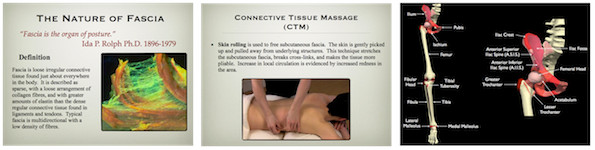
This treatment has proven to be very successful in the rehabilitation of both recent and long standing, chronic injuries. It is also of great benefit to non-sports people, increasingly referred to as ‘occupational athletes’ who develop restricted range of motion and pain from repetitive movements, poor posture and sedentary lifestyles.
Training also includes a revision of the use of Sports Massage in pre and post event situations.
Examinations and Certification
Prerequisite: Level 4 Sports Massage or equivalent

Examination: Diploma awarded by iTEC
iUSP158 Conduct Complex Assessment for Sports Massage
- Treatment evidence: 5 treatment evidence forms covering sports specific postures and gaits and biomechanical assessments
- Assignment: Research and critically evaluate complex assessment techniques
iUSP161 – Provide Complex Massage Techniques for Sports Massage
- Practical exam: 1 hour
- Treatment evidence: 5 treatment evidence forms covering Complex Sports Massage Techniques and treatment strategies.
- Assignment: Critically appraise research undertaken on the use of Sports Massage & draw conclusions on support for the use of Sports Massage
-
Fees
Course Fee: € 2,155
Exam Fee: €145Total cost: € 2,300
- Deposit of €600 – to secure your place on the course *Pay Deposit Now
- 1st Instalment of €570 – due on the first day of the course
- 2nd Instalment of €570 – due in Jan ’27
- 3rd Instalment of €560 – due in Mar ’27
-
Syllabus
Definition and detailed descriptions of techniques used in Sports Massage
Techniques for
- Preventative / conditioning massage
- Treatment of complex injuries
- Corrective massage
Understanding the appropriate type of massage movement to use in relation to the client’s condition
- Connective Tissue Massage (CTM)
- Myofascial Massage
- Soft Tissue Release (STR)
- Neuro-Muscular Technique (NMT)
- Muscle Energy Technique (MET)
- Proprioceptive Neuromuscular Facilitation (PNF)
- Orthopedic Massage
- Myoskeletal techniques
Clinical reasoning and assessment
- Body alignment, which muscles are indicated when misalignment is present
- Muscle balance
- Gait assessment
- Range of motion
- Assessment of end feel
- Functional Movement Screening
Palpation and physical assessment
- Active, Passive and Resisted testing
- Degree of swelling
- Variation in tissue temperatures
- Muscle tone and bulk
- Palpation of taught bands and Neuro-Muscular Trigger points
- Adhesions
- Previous injuries to the area
- Signs and symptoms of inflammation
Rehabilitation exercises
- Effects and benefits of stretching
- Advantages of Active Isolated Stretching
- Restoring muscle balance
- Use of resistance bands for strengthen training
Thermotherapy and Cryotherapy
- Effects and benefits
- Methods of application
- Contraindications
- Contrast bathing
Revision of the Skeletal System
- Structure and function of joints
- Bony landmarks
- Range of motion
Revision of the Muscular System
- Origin, insertion and action of the superficial and deep muscles of the body
- Muscle fibre types
- Sliding filament theory
Sports injuries
Care of the Client:
- Record Keeping
- Taking a case history
- Monitoring treatment outcomes
- Home care
Care of the Therapist:
- Postural awareness and appropriate use if body mechanics
- Joint alignment
- Self treatment and stretching
- Diet and nutrition
Contra indication to Sports Massage
- Conditions that restrict treatment either locally or totally
- Conditions requiring medical permission
-
Requirements
Each Student Requires
- 1 Pillow
- 1 Pillow Case
- 1 Towels
- Shorts
- A uniform is required for the practical examination:
- Black polo shirt
- Black tracksuit bottoms
- Black footwear
Recommended Books & Apps
- Myoskeletal & Sports Therapy – By Aubrey Gowing
- Myoskeletal Alignment Techniques – By Erik Dalton
- Apps – 3d4medical essential anatomy 5 or 3d4medical complete anatomy
-
Support
Study is supported with a fully printed course manual and through an online Learning Portal with documents and dozens of demonstration videos, a sample of which you can see here.
Dates & Locations
Times & Dates
Starting Date: Saturday 24th October 2026
Completion Date: 4th July 2027
Times: 10am – 5pm on each of the listed course days
2026
- October – 24th & 25th
2027
- January – 16th & 17th
- March – 6th & 7th
- May – 8th & 9th
- July – 2nd, 3rd, 4th
Final exams will be held in July 2027 (TBC)
*HCD reserves the right to make minor changes to the timetable where necessary due to unforeseen circumstances.
HCD, Swords, Co. Dublin
14 Main Street,
Swords,
Co. Dublin
K67 X2C8
Course Intro Video
Top 5 FAQ
-
What are the entry requirements for HCD?
Our foundation-level courses are suitable for complete beginners and do not require prior massage qualifications or experience. Advanced courses have specific entry requirements, which are listed on the relevant course page. All courses
-
Can I pay by instalments?
Yes. HCD offers payment plans on its diploma courses. The exact deposit and instalment schedule varies by course and is shown on the relevant course page. Pay an instalment
-
When does the course start?
Your studies can begin from the moment you enrol. Once you sign up, you receive access to HCD’s online learning platform and can begin working through your theory studies straight away, at your own pace. Our in-person practical classes have two main intakes each year, in April and September. Your practical classes will begin with the next available intake for the course and location you have selected. HCD’s blended-learning approach gives you 24/7 access to online lectures, quizzes and learning resources, allowing you to get started immediately and work through your theory studies at times that suit you.
-
What qualification will I receive?
The qualification depends on the course you choose. HCD offers iTEC regulated qualifications as well as HCD certificates on selected programmes. The exact award or qualification(s) you will receive are listed on the relevant course page.
-
Will I be able to work with this qualification?
Yes. HCD’s professional massage qualifications are designed to prepare graduates for professional practice. Depending on the course completed, graduates can work in settings such as massage and wellness clinics, sports environments, spas, gyms or private practice.